
What Our Clients Say
Our customers trust us to deliver exceptional results. Read what they have to say about their experience with Paint Protection Film Las Vegas
Architectural window film for Las Vegas homes and offices can help address solar heat, glare, UV exposure, privacy concerns, and certain glass-safety needs without replacing every window. In Las Vegas, NV and Henderson, NV, large windows can bring in natural light and outdoor views, but they can also admit solar energy that makes rooms less comfortable during sunny parts of the day.
Not every architectural window film does the same job.
Some films are designed mainly for solar control. Others focus on privacy or decorative appearance. Safety and security films are thicker products intended to help hold broken glass together under certain conditions. Nearly clear films are also available for property owners who want to keep the existing appearance of their windows.
Choosing the right film starts with the problem you are trying to solve.
Do you have a west-facing living room that becomes uncomfortable in the afternoon? Does glare make computer screens hard to see in your office? Are furnishings exposed to direct sunlight? Do glass conference rooms need more privacy?
Those questions can point you toward the right category of architectural film.
Architectural window film is a thin film applied to glass in homes, offices, storefronts, and other buildings.
Different products can be used to address different concerns.
Architectural films may be designed for:
3M divides its building window films into categories that include sun-control films, safety and security films, all-season films, and decorative glass films.
LLumar also separates architectural products into solar, decorative, and safety and security categories.
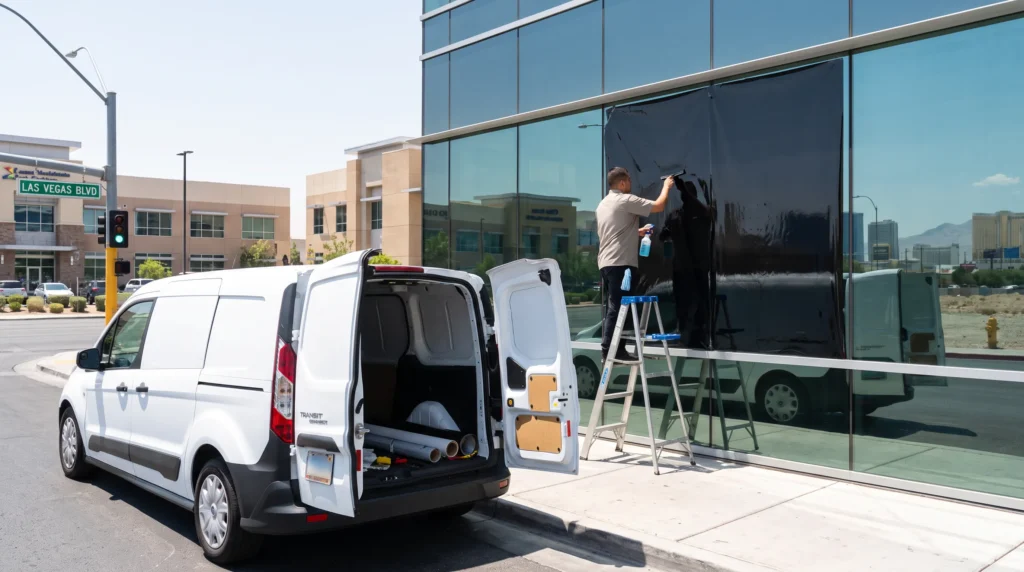
That is why asking for “window tint” alone may not tell an installer enough about what you need.
Start with the room, window, and problem.
Homes in Las Vegas, NV can have windows exposed to strong sunlight for long portions of the day.
A large living-room window can bring in beautiful desert views while also admitting solar energy.
Bedrooms, kitchens, home offices, and upstairs rooms can also feel different depending on:
The U.S. Department of Energy explains that solar radiation entering through windows can become heat after it is absorbed by interior surfaces.
That is one reason the direction and size of a window matter when choosing film.
A west-facing room may have a different problem from a north-facing room.
Rather than choosing the darkest film available, look at what needs to change inside the room.
Office windows have their own set of concerns.
Large glass areas can create glare across:
Some rooms may feel much warmer near the windows than deeper inside the building.
Commercial glass can also create privacy issues.
Conference rooms, treatment rooms, interior glass partitions, entry areas, and street-facing offices may need a different balance between visibility and privacy.
LLumar lists solar control, decorative film, safety and security film, and anti-graffiti products among its architectural choices for commercial buildings.
Film selection should match how the space is used rather than relying on one film for every window.
Solar control film is designed to reduce the amount of solar energy passing through glass.
This can help with rooms that feel noticeably warmer when direct sunlight hits the windows.
3M states that certain building window films can reject up to 81% of the sun’s heat, depending on the product and glass combination.
That number should not be treated as the performance level of every architectural film.
Different films have different specifications.
When comparing solar control film, ask for technical data on:
Those numbers can help you compare two films that may look similar.
Solar heat gain coefficient, often shortened to SHGC, is one way window performance is measured.
The U.S. Department of Energy defines SHGC as the fraction of solar radiation admitted through a window, door, or skylight, either directly or after being absorbed and released as heat indoors.
A lower SHGC means less solar heat passes through the window system.
That makes SHGC useful when comparing glass and film for hot, sunny conditions.
Visible light transmission is another measurement.
It tells you how much visible light passes through the glazing.
Those two measurements are not the same.
A film can reduce solar heat while still allowing a useful amount of visible light into the room.
When comparing architectural window film for Las Vegas, ask for both numbers rather than choosing solely by how dark the film appears.
Glare can be uncomfortable even when a room does not feel too warm.
You may notice it while:
Solar films can reduce glare by lowering the amount of visible light passing through the glass.
The amount of glare reduction depends on the film.
A darker or more reflective film may reduce more visible light, but that may not be the appearance you want.
Nearly clear solar-control products are also available.
The right balance depends on how much daylight you want to preserve.
Sunlight can contribute to fading of interior materials over time.
Window-film manufacturers offer products designed to reduce UV transmission through glass.
3M lists UV protection as one of the uses of its sun-control window films.
LLumar also markets architectural solar films for reducing UV exposure and helping slow fading.
Window film cannot guarantee that furniture, flooring, artwork, or fabrics will never fade.
UV radiation is only one factor associated with fading. Visible light, heat, material composition, dyes, and other conditions can also play a role.
If protecting interiors is a major concern, ask for the film’s published UV transmission specifications.
Privacy film can change how easily people see through a window.
There are several ways to approach privacy.
Reflective films can create a more mirror-like exterior appearance under suitable lighting conditions.
Privacy performance can change between daytime and nighttime because the brighter side of the glass tends to be easier to see from the darker side.
Do not assume reflective film provides the same privacy after dark when interior lights are on.
Frosted and etched-look films obscure direct views through glass.
These can work well for:
Patterned films can create partial privacy while still allowing light through.
This can be useful when complete visual blocking is not needed.
Decorative architectural film is used mainly to change the look of glass or add privacy.
It can imitate finishes such as:
Decorative film can work in both homes and offices.
Residential uses may include:
Office uses may include:
LLumar notes that decorative film can maintain incoming light while changing privacy and appearance.
This can be useful when blinds or curtains would block more of the natural light than you want.
Safety and security film serves a different purpose from standard solar film.
These products are designed to help hold broken glass together under certain conditions.
3M states that its Safety and Security Window Films, when used with the appropriate attachment system for specified applications, can help retain broken glass and reduce flying glass fragments.
The exact performance depends on several factors, including:
Security film should not be described as making glass unbreakable.
It does not turn a normal window into an impenetrable barrier.
For break-and-entry, windstorm, seismic, or other safety applications, the complete tested system matters.
That can include film plus an attachment sealant around the frame.
Ask for the manufacturer’s technical specifications for the exact application you are considering.
Architectural window film does not always have to make a building look dark.
Nearly clear films are available for homeowners and businesses that want solar control while preserving much of the existing glass appearance.
Reflective films create a more noticeable exterior finish.
Each has advantages depending on the property.
Do not choose based on appearance alone.
Compare the film’s published performance data.
Residential and commercial buildings can use similar categories of film, but the project requirements can differ.
Homeowners may care most about:
Businesses may care about:
Commercial projects may also involve much larger areas of glass.
Building managers may need technical specifications, warranty documentation, glass information, and project records before approving film.
Solar heat entering through glass can add to the cooling load of a building.
The U.S. Department of Energy explains that a lower solar heat gain coefficient reduces the amount of solar heat transmitted through a window.
Solar-control film can alter the performance of existing glazing by reducing solar energy passing through it.
That does not mean every building will see the same change in energy use.
Results can depend on:
3M markets its building films as a way to reduce solar heat and potentially reduce energy use.
LLumar states that commercial window film can produce energy savings in some buildings.
Treat those claims as product and project dependent rather than guaranteed savings for every Las Vegas property.
Window film and replacement windows solve different problems.
Film modifies the performance or appearance of existing glass.
Replacement changes the window assembly itself.
Film may make sense when the existing windows are structurally sound but you want:
Window replacement may make more sense when there are problems such as:
Window film should not be presented as a repair for a failing window assembly.
Have the actual problem identified first.
Not every film is suitable for every piece of glass.
The installer needs to consider:
Certain film and glass combinations can create more thermal stress than others.
That is why manufacturer-approved film selection matters.
Before installation, the glass type should be identified as accurately as possible.
If the property has insulated glass or low-E windows, tell the film installer.
Start with the problem rather than the film shade.
Look at solar-control film and compare solar heat performance.
Compare visible light transmission and glare reduction.
Look at reflective, frosted, or decorative films depending on whether you still want an outdoor view.
Ask about UV transmission and solar-control performance.
Discuss tested safety and security film systems.
Look at decorative architectural film.
Here’s what matters: one film does not have to solve every problem.
A home may need one product on west-facing living-room glass and a different film on bathroom windows.
An office may use solar film on exterior glass and frosted film on interior conference rooms.
Architectural window film and automotive window tint are separate product categories.
They should not be treated as interchangeable.
Building glass and vehicle glass have different:
Use architectural film designed and approved for the building-glass application.
Use automotive film for vehicle windows.
Paint Protection Film Las Vegas currently lists automotive window tint among its vehicle services.
If you are looking for architectural window film for a home or office, call first to confirm whether that service is currently available.
Before agreeing to an architectural film installation, ask:
Get the exact product name.
The installer should identify the glass and choose a suitable product.
This tells you how much visible light passes through.
Ask for manufacturer specifications rather than a verbal estimate.
Look at samples when possible.
Do not assume a reflective daytime appearance guarantees privacy at night.
Ask for the manufacturer’s written warranty.
Safety and security applications may call for more than film alone.
This can matter for HOAs, property managers, landlords, or commercial buildings with appearance rules.
Architectural window film for Las Vegas homes and offices can address several common concerns, but film selection should be based on the building and glass rather than choosing the darkest product available.
For Las Vegas, NV and Henderson, NV properties, the conversation may include solar heat, glare, privacy, fading, decorative glass, or safety.
Paint Protection Film Las Vegas is located at:
7585 Commercial Way Suite H Henderson, NV 89011
Our published services currently focus on vehicle protection and customization, including:
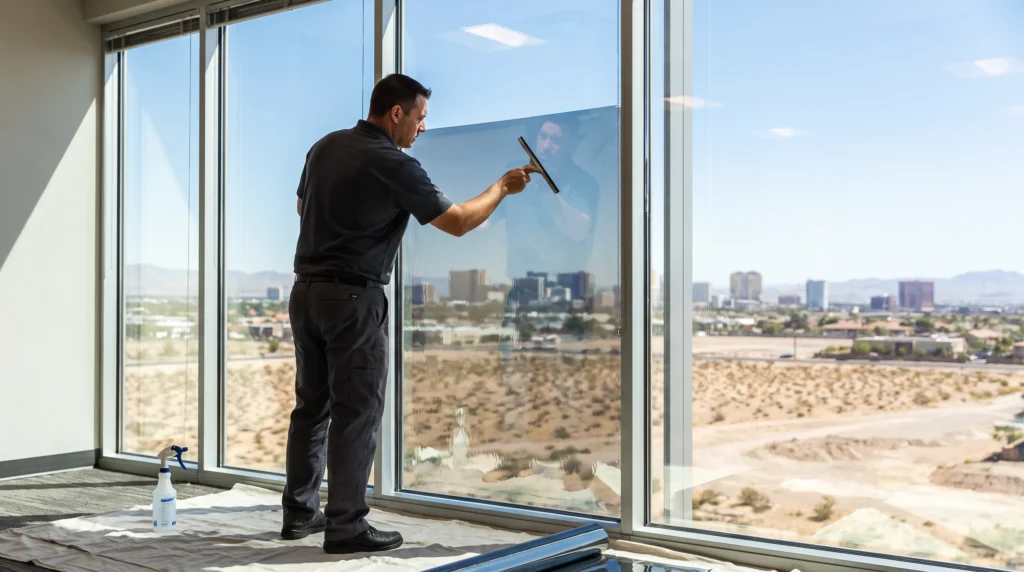
If you want to ask whether architectural window film is available for your Las Vegas, NV or Henderson, NV property, call (725) 318-7445 or visit our contact page.
Business hours are Monday through Friday from 9 AM to 6 PM. Saturday is available by appointment.
Solar-control window film can reduce the amount of solar energy passing through suitable glass. The result depends on the film, glass type, window direction, shading, and other building conditions. Ask for the manufacturer’s performance data for the film being considered.
Yes. Solar-control films can reduce visible light passing through glass and reduce glare. Different films offer different levels of visible light transmission, so choose a product that balances glare reduction with the amount of daylight you want.
Yes. Reflective, frosted, and decorative films can provide different levels of privacy. Reflective film may provide stronger privacy during the day than at night when interior lights are on, so discuss your day and nighttime needs before choosing.
Many architectural solar-control films are made to reduce UV transmission. Check the technical specifications for the exact film rather than assuming every product has the same performance.
No. Safety and security film does not make glass unbreakable. Certain systems are designed to help retain broken glass and delay penetration under specified conditions. Film type, glass, frames, attachment systems, and installation all affect performance.
Some architectural films are compatible with certain insulated and Low-E glass systems, but not every film belongs on every glass type. The glass should be identified and matched with a manufacturer-approved film before installation.
Paint Protection Film Las Vegas is located at 7585 Commercial Way Suite H, Henderson, NV 89011. Our current published sitemap lists automotive window tint rather than a dedicated architectural film service. Call (725) 318-7445 or use our contact page to confirm whether home or office window-film service is currently available.
How Long Does Ceramic Coating Last in the Las Vegas Desert Heat?. How long does ceramic coating last in the Las Vegas desert heat is the question we hear most from drivers in Las Vegas, NV and Henderson, NV. The short answer: a professionally installed coating that’s prepped and maintained correctly can deliver multi-year durability even under intense sun and dust. The longer answer depends on paint condition, product choice, where you park, and how you wash. Let’s break it down so you can decide what’s right for your vehicle.
Complete Vehicle Protection & Customization
We specialize in Paint Protection Film (PPF), Color PPF, Ceramic Coating, and Paint Correction to keep your vehicle looking showroom-new for years to come.
From Window Tint to Vinyl Wraps and Commercial Wraps, we offer comprehensive customization solutions that combine style with function.


Experience the difference that precision craftsmanship and attention to detail can make. Call us at (725) 318-7445 or request a free quote to get started on your vehicle protection project.
Visit Our Shop